



If you’ve started to notice that close-up tasks aren’t as easy as they used to be, one of the first questions you’ll probably ask is whether you need ready-made reading glasses or a prescription pair. It’s a common question, and the answer is simpler than you might think.
Both options serve the same basic purpose – helping you see clearly up close – but they work in slightly different ways and suit different needs. In this article, we’ll explain the key differences, help you understand which option is right for you, and clear up some of the most common misconceptions.
What Are Ready-Made Reading Glasses?
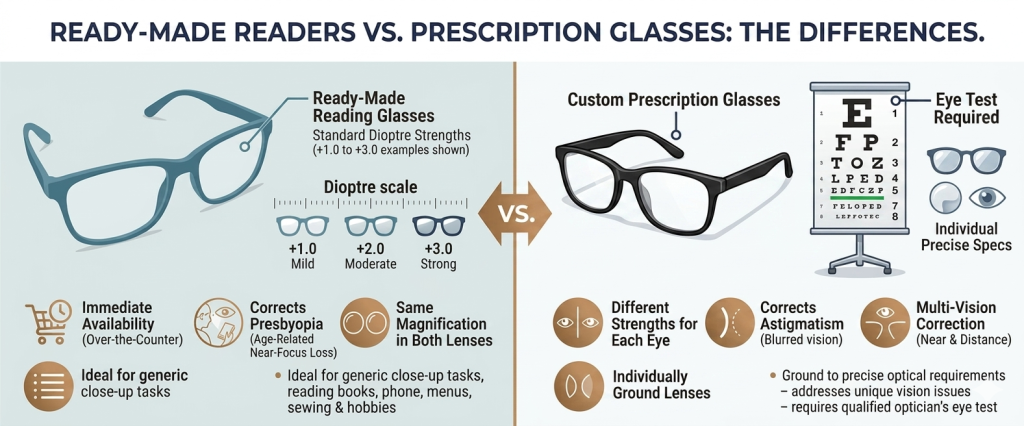
Ready-made reading glasses, sometimes called ready readers or over-the-counter readers, are pre-made glasses with magnifying lenses designed to help with close-up tasks. They come in standard dioptre strengths, typically ranging from +1.0 to +3.0, and have the same magnification in both lenses.
They’re designed for people experiencing presbyopia – the natural, age-related loss of near-focus ability that affects virtually everyone from their early to mid-forties onwards. You don’t need a prescription to buy them, and they’re available immediately without waiting for custom lenses to be made.
Ready-made reading glasses are ideal for general close-up tasks such as reading books, newspapers, and menus, using your phone or tablet, cooking and reading recipes, crafting, sewing, and hobbies, and general day-to-day tasks involving small print.
What Are Prescription Glasses?
Prescription glasses are custom-made to your exact optical requirements following an eye test carried out by a qualified optician. The lenses are ground to a precise specification for each eye individually, which means they can correct a wide range of vision issues beyond simple close-up magnification.
Prescription lenses can address different strengths needed in each eye, astigmatism (where the eye’s surface is an irregular shape, causing blurred or distorted vision), a combination of near and distance vision correction (varifocals or bifocals), and specific occupational requirements, such as intermediate-distance computer work.
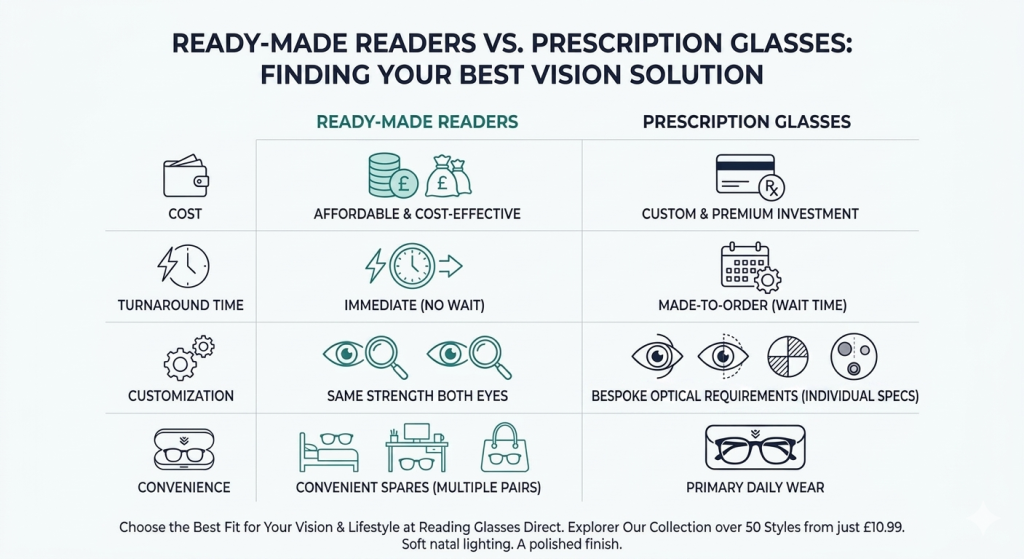
Because they’re made to order, prescription glasses typically take longer to receive and cost more than ready-made readers.
When Ready-Made Reading Glasses Are the Right Choice
For many people, ready-made reading glasses are the most practical and cost-effective option. They’re particularly well-suited if you need the same level of magnification in both eyes, your main difficulty is with close-up tasks rather than distance vision, you want the convenience of buying multiple pairs at an affordable price, you’d like spare pairs to keep in different locations – by the bed, at your desk, in your bag, or you need glasses quickly without waiting for a prescription to be filled.
The majority of people who develop presbyopia in their forties and beyond fall into this category. Ready-made readers provide clear, comfortable vision for everyday close-up tasks at a fraction of the cost of prescription lenses.
When Prescription Glasses Are the Better Option
There are certain situations where a prescription pair will serve you better. You should consider visiting an optician and getting prescription reading glasses if there’s a significant difference in the vision between your two eyes, you’ve been diagnosed with astigmatism, you need correction for both near and distance vision, you experience persistent headaches, eye strain, or visual distortion that doesn’t improve with different ready-reader strengths, or you have an existing eye condition that requires monitoring.
If you’re unsure, an eye test is always a worthwhile investment. It can confirm whether ready-made readers are suitable or whether you’d benefit from a bespoke prescription.
Can You Use Both?
Many people do. It’s very common to own a primary prescription pair for daily wear alongside one or more pairs of ready-made reading glasses as convenient spares. Ready readers make excellent backup pairs to keep at home, at work, or while travelling – providing reliable close-up clarity without the worry of losing or damaging an expensive prescription pair.
Common Misconceptions
There are a few myths worth clearing up.
“Ready-made reading glasses will damage my eyes.” This is not true. Wearing ready readers that are slightly too strong or too weak may cause temporary discomfort or strain, but they will not cause any lasting harm to your eyes.
“I should only wear reading glasses from an optician.” If your close-up vision needs are straightforward and the same in both eyes, high-quality ready-made readers are a perfectly suitable option. All our Magnif Eyes reading glasses feature aspheric lenses and comply with current safety standards.
“Cheap reading glasses are poor quality.” Price and quality are not always linked. What matters is the lens quality, frame construction, and comfort. Our reading glasses are sourced from brands stocked by well-known UK high street retailers, and every pair comes with a protective case and lens-cleaning cloth included.
Making the Right Choice
The decision between ready-made and prescription reading glasses comes down to your individual vision needs, lifestyle, and budget. For the majority of people experiencing presbyopia, ready-made readers offer an excellent combination of quality, convenience, and value.
Explore our collection of over 50 styles at Reading Glasses Direct, with magnifications from +1.0 to +3.0 and prices starting from just £10.99.