




Choosing the right strength for your reading glasses is one of the most important decisions you’ll make when buying a pair. Too weak and you’ll still be squinting. Too strong and you may experience headaches or discomfort. The good news is that finding your ideal strength is straightforward, and you don’t necessarily need a trip to the optician to get started.
In this guide, we’ll walk you through everything you need to know about reading glasses strengths – what the numbers mean, how to find the right one for you, and when it might be worth seeking professional advice.
What Do the Numbers Mean?
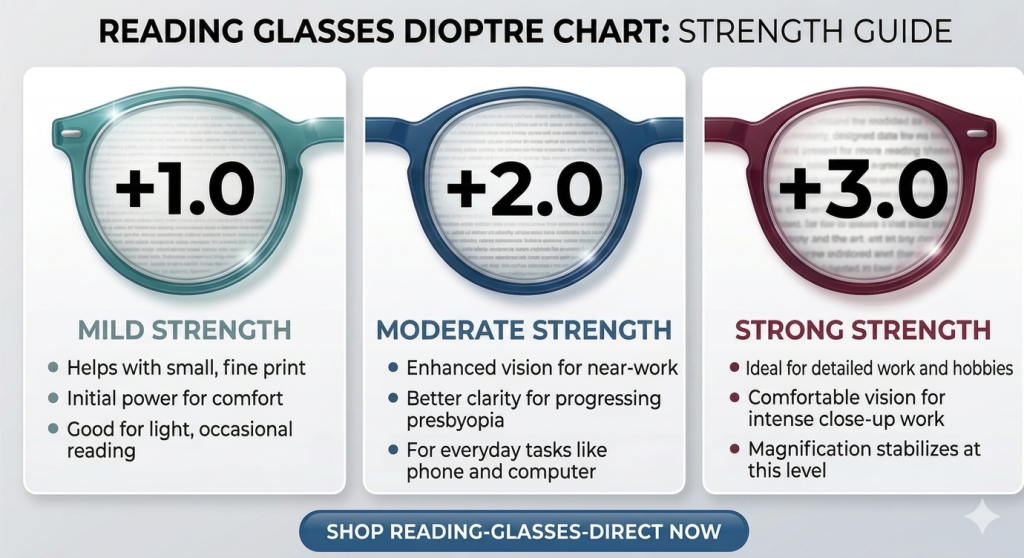
Reading glasses are measured in dioptres, written with a plus sign – for example, +1.0, +1.5, +2.0, and so on. The number refers to the magnification power of the lenses. A lower number means milder magnification, while a higher number provides stronger magnification.
At Reading Glasses Direct (https://www.reading-glasses-direct.co.uk/), our range covers +1.0 to +3.0 dioptres, which suits the vast majority of people who need ready-to-wear reading glasses.
A General Guide by Age
While everyone’s eyes are different, there are some common patterns in how reading glasses strength tends to correspond with age. This is a guide only – your individual needs may vary.
Early to mid-40s – Most people start to notice changes in their close-up vision around this age. A strength of +1.0 to +1.5 is often sufficient for comfortable reading.
Late 40s to early 50s – As presbyopia progresses, you may find that a strength of +1.5 to +2.0 provides better clarity for everyday tasks like reading, using your phone, or working at a computer.
Mid-50s to early 60s – Many people in this age range find that +2.0 to +2.5 gives them the most comfortable vision for close-up work.
Mid-60s and beyond – Presbyopia tends to stabilise around the age of 60 to 65. Strengths of +2.5 to +3.0 are common, though some people settle at a lower strength depending on their individual eyes.
It’s worth remembering that these are general guidelines. The best way to determine your ideal strength is to test for yourself.
How to Test Your Reading Glasses Strength at Home
You don’t need specialist equipment to find the right strength. Here’s a simple method you can try at home. Once you have bought your glasses from https://www.reading-glasses-direct.co.uk/, you may try the following steps
Step 1: Find a piece of printed text at a size you’d normally read – a book, newspaper, or magazine works well.
Step 2: Hold the text at a comfortable reading distance. For most people, this is around 35 to 40 centimetres from your eyes – roughly the length of your forearm.
Step 3: If you already have a pair of reading glasses, try them on. If the text appears clear and comfortable without needing to move it closer or further away, the strength is likely right for you.
Step 4: If the text is still blurry, you may need a slightly stronger pair. If the text is clear but feels uncomfortably magnified or you need to hold it further away than feels natural, the strength may be too high.
Step 5: If you’re choosing your first pair, start with the lowest strength (+1.0) and work upwards. The correct strength is the lowest one that makes the text clear and comfortable at your natural reading distance.

Signs You're Wearing the Wrong Strength
Even if you’ve been wearing reading glasses for a while, it’s worth checking whether your current strength is still right for you. Presbyopia is a gradual process, and your needs may change over time.
Common signs that your reading glasses strength isn’t quite right include headaches after reading or close-up work, eye strain or fatigue that develops during the day, needing to hold text noticeably closer or further away than feels natural, and squinting even while wearing your glasses.
If you’re experiencing any of these, it may be time to try the next strength up – or in some cases, down.
When to See an Optician
Ready-to-wear reading glasses are an excellent, convenient option for the majority of people experiencing age-related close-up vision changes. However, there are some situations where a visit to an optician is the better choice.
You should consider booking an eye test if you find that you need a noticeably different strength in each eye, you experience distortion, double vision, or persistent headaches that don’t improve with a strength change, you have a pre-existing eye condition such as glaucoma, cataracts, or macular degeneration, or you’ve noticed a sudden change in your vision rather than a gradual one.
An optician can carry out a full eye examination and, if needed, prescribe lenses tailored to your individual requirements.
Find Your Perfect Pair at https://www.reading-glasses-direct.co.uk/
Once you know your strength, finding the right reading glasses is the enjoyable part. At Reading Glasses Direct, we stock over 50 styles in magnifications from +1.0 to +3.0, with every pair supplied with a protective case and lens-cleaning soft case included.
Whether you prefer a classic look, a bold contemporary frame, or a lightweight rimless design, there’s something in our collection for you – all from just £10.99.